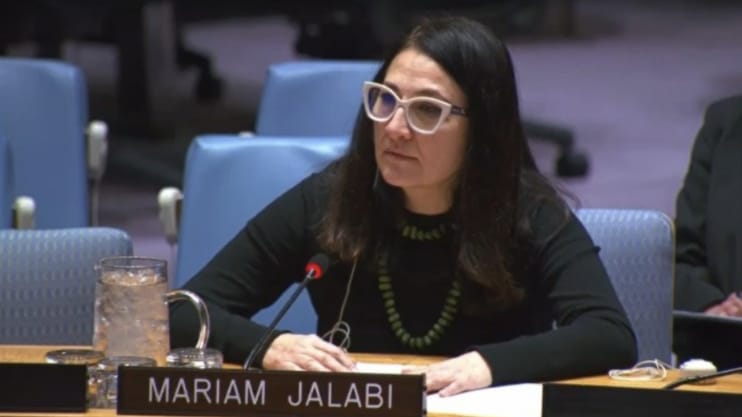
Member of the General Secretariat, Mariam Jalabi, briefing the United Nations Security Council on Syria – 18 December 2025
- updated: December 18, 2025
President, Excellencies,
Thank you for the opportunity to deliver this statement. Allow me to begin with a brief message in Arabic.
I address my words to Syrian women and men everywhere — inside the country and across the diaspora; to those who have returned to confront their losses and their wounds; to the martyrs of the Syrian revolution; to those who said “no” in the face of injustice, paid a heavy price, and did not live to witness the great day of joy with the fall of Assad.
To those who remain in the camps, and to those who still hold on to hope that justice will be delivered — let us celebrate the anniversary of our liberation.
Let us continue this path together, with awareness and responsibility, and with determination that the voice of the great Syrian people be the source and compass of all authority.
Excellencies,
My name is Mariam Jalabi — I am a daughter of the Syrian revolution, from Qamişlo and the Golan Heights. I represent the Syrian Women’s Political Movement.
Like many Syrians, my struggle is deeply personal. My father, Khales Jalabi, was imprisoned multiple times in Assad’s prisons — as were relatives, friends, and countless Syrians whose lives were marked by fear and persecution under the regime.
December 8, 2024 marked Syria’s liberation — a historic turning point, a new dawn that opened the door to building a country that all Syrians can claim as their own, rooted in equality, justice, and dignity.
On January 5, 2025, I returned to Syria after fourteen years in exile. At the border, I was told I had been wanted by three security branches — yet the officer smiled and said, “Welcome home.” I entered my country without fear. Later, I brought my family for the first time to show them that we now have a country we can finally call home.
What I share today is not an abstract political appeal. It is the voice of women and families who lived for 54 years under the brutal Assad regime and paid the ultimate price for freedom over the past fourteen years.
Excellencies,
The road ahead is turbulent and demanding, but allow me to outline a path forward built on three interdependent pillars.
First pillar — A political transition anchored in democratic principles and the rule of law
This means, as stipulated by Resolution 1325 (2000), recognizing women as full partners in a new Syria and architects of its constitutional, economic, and political future. My message to you is clear: we stand ready for the work it requires.
Yet, today, women hold only five percent of seats in the People’s Assembly[1] and one ministerial position,[2] making women’s representation far from where it needs to be. Genuine political engagement, with a guarantee of at least 30 percent women’s inclusion — moving toward parity — is critical for national commissions, constitutional processes, elections, local governance, security-sector reform and economic planning.
Further, it is essential to open civic and political space so people can freely express themselves and form political parties reflecting their vision for a pluralistic Syria.
The role of civil society, having carried the struggle for the past fourteen years, must also be affirmed as an essential partner.
All of this must be anchored in the spirit of Resolution 2254 (2015),[3] reaffirmed by Resolution 2799 (2025),[4] as a roadmap for an inclusive, Syrian-led transition.
Second pillar — Protecting the human rights of every Syrian, without exception
The true measure of any transition lies in the safety and dignity of all civilians regardless of identity or geography.
Lives continue to be lost to massacres[5] and sexual and gender-based violence,[6] putting entire communities in grave danger. On December 8, Syrians collectively vowed “never again.” Now we must turn that vow into reality.
This means:
- An end to abductions, torture and organized violence, especially all forms of gender-based violence, by all parties.
- Justice and accountability must be core principles of the political transition, with women’s rights at the center, including through the National Commission for Transitional Justice.
- Clarifying the fate of all disappeared and missing persons, and ensuring support for their families, including through the National Commission for the Missing. No family can heal while loved ones are unaccounted for.
- A comprehensive national law to prevent and respond to gender-based violence.
- A commitment to reform and refrain from adopting any new discriminatory laws on personal status, nationality, labor and education, in line with international standards. This includes the directive issued recently barring mothers from having custody over their children.[7]
- The withdrawal of the Assad regime’s reservations to the Convention on the Elimination of All Forms of Discrimination against Women (CEDAW),[8] which undermine its core guarantees of equality and non-discrimination, including on freedom of movement and equal rights in marriage.
Protection also means protection from external aggression and violations of sovereignty. When I returned to Syria in January, I found Israeli forces occupying my village in the Golan Heights. Last week, the doors were blown off my family home. I know, firsthand, how occupation strips communities of dignity and belonging. Syrians in the Golan, like all Syrians, deserve to live free of violence, occupation and fear.
No transition can gain trust without safety. No peace can hold without justice. And no future can be built without inclusivity — of all Syrians, including women, civil society, youth and other marginalized groups.
Third pillar — Sustainable economic recovery
Excellencies,
The continued lifting of broad sanctions is essential for economic recovery, without which we cannot rebuild. Over 90 percent of Syrians live under the poverty line.[9] Over 50 percent of education and healthcare infrastructure,[10] and one-third of housing,[11] have been damaged or destroyed. More than 2.5 million children are out of school.[12]
These are not just statistics — they are warnings that without ensuring economic dignity, we are condemning a generation to uncertainty.
Women and girls are deeply affected by this economic crisis.[13] When men were killed, disappeared, detained or displaced, gender roles began to shift. In addition to continuing the unpaid and invisible gendered labor of caring for their families and the injured, millions of women became sole providers.[14] They did this during conflict without access to formal work, banking, land ownership, documentation or support.[15] They continued doing this while facing gender-based violence and legal discrimination.[16]
Economic recovery must include women at its core, because they are rooted in the needs of their own communities. Also, the national reconstruction plan must include rural and heavily damaged areas, not only major cities.
In light of all these challenges, at such a sensitive moment in Syria’s transition, I urge the Security Council to:
- Initiate discussions on how best to support an inclusive, rights-based, Syrian-owned and Syrian-led transition, including through a new UN presence.
- Demand the full, equal, meaningful and safe participation of all women at all levels of Syria’s transition, and respect for their human rights, in accordance with the Security Council’s resolutions on Women, Peace and Security.[17]
- Call on the Syrian authorities to work with women civil society to develop, adopt and fully implement a Syrian National Action Plan on Women, Peace and Security.
- Demand an end to continued Israeli aggression in Syria and full withdrawal to the 1974 line in accordance with the disengagement agreement.[18] Failure to do so endangers civilians and undermines regional security.
- Finally, the Syrian people want justice. Hold Assad and his collaborators accountable, including by referring the situation in Syria to the International Criminal Court.
Excellencies,
Syria does not need guardianship. It needs partnership — shared responsibility between Syrians and the international community.
Peace will not be built by political arrangements alone, but through justice and unwavering respect for the dignity of every Syrian.
Let me conclude as I began, in Arabic: Long live free and independent Syria, and long live the great Syrian people.
Thank you.
[1] Women won six of 119 available seats in the October 2025 People’s Assembly elections. Briefing by Deputy Special Envoy of the Secretary-General for Syria, Najat Rochdi, to the Security Council, 22 October 2025, S/PV.10021, https://docs.un.org/en/S/PV.10021.
[2] Hélène Sallon, “Hind Kabawat, the only woman in Syria’s transitional government: ‘Al-Sharaa has a vision, and he knows he cannot govern alone’,” Le Monde, 2 April 2025, https://www.lemonde.fr/en/international/article/2025/04/02/hind-kabawat-labor-minister-and-the-only-woman-in-the-syrian-transitional-government-al-sharaa-has-a-vision-and-he-knows-he-cannot-govern-alone_6739757_4.html.
[3] Resolution 2254 (2015), undocs.org/s/res/2254(2015).
[4] Resolution 2799 (2025), undocs.org/s/res/2799(2025).
[5] See Human Rights Watch, “‘Are You Alawi?’ Identity-Based Killings During Syria’s Transition,” 23 September 2025, https://www.hrw.org/report/2025/09/23/are-you-alawi/identity-based-killings-during-syrias-transition; Amnesty International, “Syria: New investigation reveals evidence government and affiliated forces extrajudicially executed dozens of Druze people in Suwayda,” 2 September 2025, https://www.amnesty.org/en/latest/news/2025/09/syria-new-investigation-reveals-evidence-government-and-affiliated-forces-extrajudicially-executed-dozens-of-druze-people-in-suwayda/; Independent International Commission of Inquiry on the Syrian Arab Republic, “Violations against civilians in the coastal and western-central regions of the Syrian Arab Republic (January-March 2025),” 11 August 2025, A/HRC/59/CRP.4, https://www.ohchr.org/sites/default/files/documents/hrbodies/hrcouncil/sessions-regular/session59/a-hrc-59-crp4-en.pdf.
[6] OHCHR, “Syria: UN experts alarmed by attacks on Druze communities, including sexual violence against women and girls,” 21 August 2025, https://www.ohchr.org/en/press-releases/2025/08/syria-un-experts-alarmed-attacks-druze-communities-including-sexual-violence; Independent International Commission of Inquiry on the Syrian Arab Republic, “Violations against civilians in the coastal and western-central regions of the Syrian Arab Republic (January-March 2025),” Annex II, Section I(Q), 11 August 2025, A/HRC/59/CRP.4, https://www.ohchr.org/sites/default/files/documents/hrbodies/hrcouncil/sessions-regular/session59/a-hrc-59-crp4-en.pdf; Amnesty International, “Syria: Authorities must investigate abductions of Alawite women and girls,” 28 July 2025, https://www.amnesty.org/en/latest/news/2025/07/syria-authorities-must-investigate-abductions-of-alawite-women-and-girls/; OCHA, “Syrian Arab Republic: Humanitarian Response Priorities (January to December 2025),” pp. 24-25, 24 July 2025, https://reliefweb.int/report/syrian-arab-republic/syrian-arab-republic-humanitarian-response-priorities-january-december-2025.
[7] Hawar News Agency, “Syrian Women’s Council rejects Ministry of Justice circular excluding mothers from child guardianship,” 18 December 2025, https://hawarnews.com/en/syrian-womens-council-rejects-ministry-of-justice-circular-excluding-mothers-from-child-guardianship; Syrian Feminist Lobby, “Disgraceful Circular No. 17,” 18 December 2025, https://syrianfeministlobby.org/en/2025/12/18/disgraceful-circular-no-17/ [contains text of circular in Arabic].
[8] Syria has reservations to: Article 2; Article 9, paragraph 2; Article 15, paragraph 4; Article 16, paragraphs 1(c), (d), (f) and (g); Article 16, paragraph 2; and Article 29, paragraph 1. United Nations Treaty Series, Convention on the Elimination of All Forms of Discrimination against Women, pp. 9-10, accessed 15 December 2025 https://treaties.un.org/doc/Publication/MTDSG/Volume%20I/Chapter%20IV/IV-8.en.pdf.
[9] OCHA, “Syrian Arab Republic: Humanitarian Response Priorities (January to December 2025),” p. 8, 24 July 2025, https://reliefweb.int/report/syrian-arab-republic/syrian-arab-republic-humanitarian-response-priorities-january-december-2025.
[10] UNDP, “The Impact of the Conflict in Syria: A Devastated Economy, Pervasive Poverty and a Challenging Road Ahead to Social and Economic Recovery,” p. 9, 24 February 2025, https://www.undp.org/sites/g/files/zskgke326/files/2025-02/undp-sy-seia-final-24022025_compressed.pdf.
[11] OCHA, “Syrian Arab Republic: Humanitarian Response Priorities (January to December 2025),” p. 45, 24 July 2025, https://reliefweb.int/report/syrian-arab-republic/syrian-arab-republic-humanitarian-response-priorities-january-december-2025.
[12] UNICEF, “Humanitarian Action for Children 2026 – Syrian Arab Republic,” p. 2, 10 December 2025, https://reliefweb.int/report/syrian-arab-republic/humanitarian-action-children-2026-syrian-arab-republic.
[13] OCHA, “Syrian Arab Republic: Humanitarian Response Priorities (January to December 2025),” p. 15, 24 July 2025, https://reliefweb.int/report/syrian-arab-republic/syrian-arab-republic-humanitarian-response-priorities-january-december-2025; UNDP, “The Impact of the Conflict in Syria: A Devastated Economy, Pervasive Poverty and a Challenging Road Ahead to Social and Economic Recovery,” p. 31, 24 February 2025, https://www.undp.org/sites/g/files/zskgke326/files/2025-02/undp-sy-seia-final-24022025_compressed.pdf.
[14] Joumana Seif, Sima Nassar and Rima Filhan, “Death is not the worst that can happen…it is also the waiting!” Syrian Feminist Lobby, pp.15-16, 4 April 2024, https://syrianfeministlobby.org/en/2024/03/05/death-is-not-the-worst-that-can-happen-it-is-also-the-waiting-2/; Women Now for Development, “Syrian Women’s Readings of the Present, Future, and Associated Concepts,” pp. 42-46, September 2020, https://women-now.org/wp-content/uploads/Syrian_Women’s_Readings_of_the_Present,Future,and_Associated_Concepts.pdf.
UNFPA, “Voices from Syria 2025: Assessment Findings of the Humanitarian Needs Overview,” p. 34, 14 October 2025, https://syria.unfpa.org/en/publications/voices-syria-2025-assessment-findings-humanitarian-needs-overview [noting that women “are still carrying a severe double-burden of paid and unpaid work”]; CARE International, “Rapid Gender Analysis: Sacrificing the Future to Survive the Present: Findings from North-West Syria,” pp. 8-9, 15 March 2022, https://reliefweb.int/report/syrian-arab-republic/care-rapid-gender-analysis-syria-sacrificing-future-survive-present.
[15] OCHA, “Syrian Arab Republic: Humanitarian Response Priorities (January to December 2025),” pp. 24-25, 24 July 2025, https://reliefweb.int/report/syrian-arab-republic/syrian-arab-republic-humanitarian-response-priorities-january-december-2025; Joumana Seif, Sima Nassar and Rima Filhan, “Death is not the worst that can happen…it is also the waiting!” Syrian Feminist Lobby, pp.15-16, 4 April 2024, https://syrianfeministlobby.org/en/2024/03/05/death-is-not-the-worst-that-can-happen-it-is-also-the-waiting-2/; Independent International Commission of Inquiry on the Syrian Arab Republic, “Gendered Impact of the Conflict in the Syrian Arab Republic on Women and Girls,” pp. 4-5, 13-15, 12 June 2023, https://www.ohchr.org/sites/default/files/documents/hrbodies/hrcouncil/coisyria/policypapersieges29aywar/2023-06-12-Gendered-impact-women-girls-%20Syria.pdf.
[16] Lina Ghoutouk, “Wives of the Disappeared in Syria: Voices in Legal Limbo,” Tahrir Institute for Middle East Policy, 10 December 2025, https://timep.org/2025/12/10/wives-of-the-disappeared-in-syria-voices-in-legal-limbo/; Gender-Based Violence Area of Responsibility and UNFPA, “Advocacy Brief: An Overview of Gender-Based Violence in Syria – 2025,” pp. 5-7, 23 June 2025, https://reliefweb.int/report/syrian-arab-republic/advocacy-brief-overview-gender-based-violence-syria-2025; Syrian Feminist Lobby, “Paper on the Principles of the Syrian Civil Family Law,” 10 December 2024, https://syrianfeministlobby.org/en/2024/03/05/paper-on-the-principles-of-the-syrian-civil-family-law-2/; Independent International Commission of Inquiry on the Syrian Arab Republic, “Gendered Impact of the Conflict in the Syrian Arab Republic on Women and Girls,” pp. 4-9, 12-15, 12 June 2023, https://www.ohchr.org/sites/default/files/documents/hrbodies/hrcouncil/coisyria/policypapersieges29aywar/2023-06-12-Gendered-impact-women-girls-%20Syria.pdf.
[17] Resolutions 1325 (2000), undocs.org/s/res/1325(2000); 1820 (2008), undocs.org/s/res/1820(2008); 1888 (2009), undocs.org/s/res/1888(2009); 1889 (2009), undocs.org/s/res/1889(2009); 1960 (2010), undocs.org/s/res/1960(2010); 2106 (2013), undocs.org/s/res/2106(2013); 2122 (2013), undocs.org/s/res/2122(2013); 2242 (2015), undocs.org/s/res/2242(2015); 2467 (2019) undocs.org/s/res/2467(2019); and 2493 (2019), undocs.org/s/res/2493(2019).
[18] Agreement on Disengagement between Israeli and Syrian Forces, 31 May 1974, https://history.state.gov/historicaldocuments/frus1969-76v26/d88.