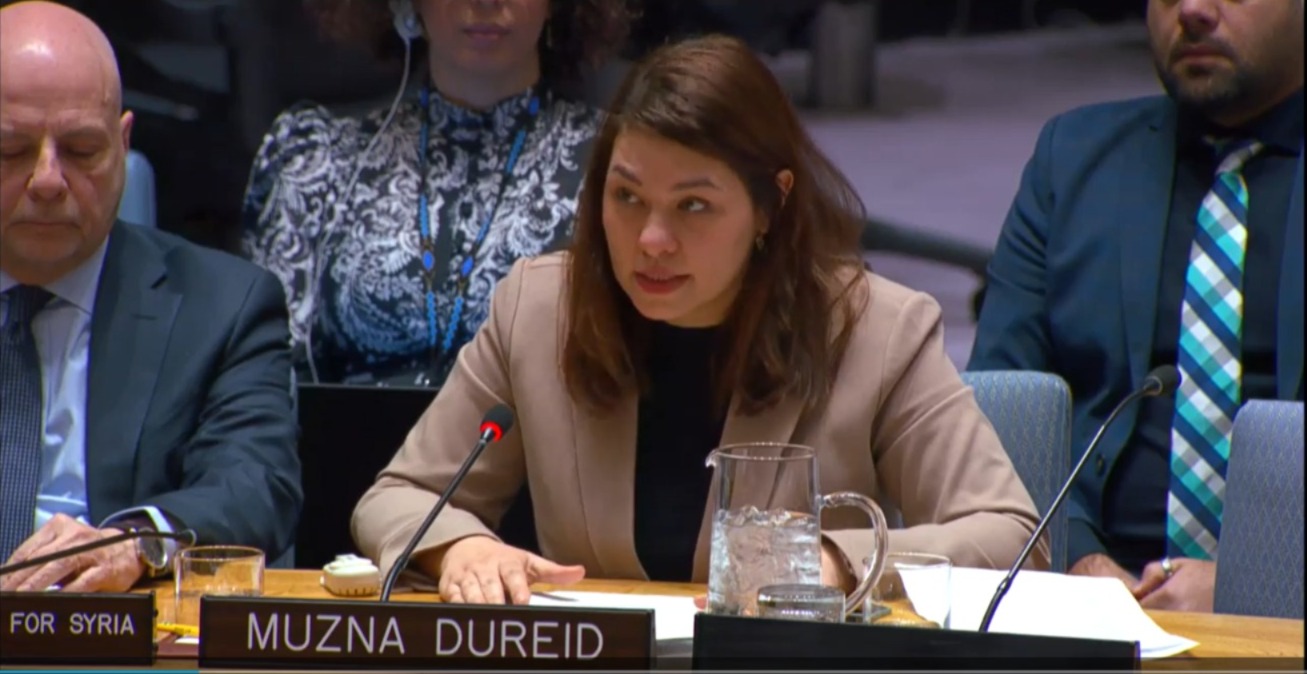
Muzna Dureid’s Briefing to the UN Security Council – February 13, 2026
- updated: February 14, 2026
Mr. President, Excellencies, distinguished members of the Security Council, thank you for the opportunity to brief you today.
My name is Muzna Dureid. I’m a Syrian woman, a daughter, a mother, an advocate, and a former refugee. I’m from Alkadam, in Damascus, a neighbourhood that was levelled to the ground by Assad regime and its allies, where my family witnessed 5 years of siege, bombardments, mass killing, detention, and forced displacement.
I came to Canada in 2016 as a young asylum seeker with no plan except survival. I started over, but I never left Syria behind. I kept working through civil society for women’s rights, displaced communities, and humanitarian response.
Like many Syrians, the fall of Assad gave me enough hope to permanently return home not because Syria was ready or my neighborhood is livable, but because Syria needs all of us, and the risk of apathy is higher than engaging.
Despite some positive developments and the return of over 3 million displaced persons, the northeast remains unstable. Unlawful Israeli interventions continue. A year without a legislative body, sectarian violence and external tutelage persist in Swieda and the coast. At the same time, a collapsed economy is exacerbated by current neoliberal policies. Syria cannot be rebuilt on half-measures, political pragmatism over the rule of law, while the international community is trapped between cautious engagement and costly hesitation.
Given this pivotal moment in Syria, I am here to urge this Council and the international community to act in three critical areas.
First: Women’s Participation
As we convene here in New York, my colleagues in the Syrian Women’s Political Movement are holding our General Assembly in Beirut, not Damascus. We requested to meet in Syria, but the Ministry of Foreign Affairs did not grant permission. How can inclusive political laws be shaped if those advocating for them cannot even convene?
Look at the cabinet: one female minister. Look at the recent diplomatic appointments: not a single woman. Syria did better in the 1940s, appointing Alice Kandalaft to the United Nations. Eighty years later, this is not about capacity; it is about political will. Without Syrian women, the transition will not be legitimate.
Syrian women paid the highest price during the Syrian revolution. Yet women continue to face security threats, including sectarian abduction, killing, and patriarchal mindsets in the system and society.
As a woman returning to Syria, I face constraints men do not. Rights that require permission are not rights.
Second: Transitional Justice
Assad fled Syria, but his system and legacy did not. Syrians can only heal if we see Assad behind bars. We cannot accept impunity for him or immunity for his enablers, like Mohammed Hamsho or Fadi Saqer. Granting immunity behind closed doors undermines the transition and reinforces that justice serves elites rather than victims.
When Syrian forces were deployed to the coast and Sweida in 2025, serious violations were committed, fueled by identity and sectarian hatred. Investigations followed. Accountability didn’t.
What blocks justice? Loyalty over competence and rule of law. Secrecy over transparency. And hate speech that turns neighbours into targets.
Three actions are essential for Syria: First, join the Rome Statute and grant jurisdiction to the International Criminal Court. Second, strengthen national institutions to address past and present violations, working closely with UN mechanisms, including the IIMP and IIIM. Third, give victims and survivors real agency, not tokenistic roles.
True liberation means breaking with the past, but when arbitrary arrest, forced disappearance, and extrajudicial violence continue under different flags, this is not a liberation, it’s betrayal.
Third: Security and Stabilization
The recent decree addressing Syrian Kurds’ citizenship rights, unresolved since the 1960s, is welcome and long-awaited. However, genuine inclusion requires political participation and equal representation reflected in constitutional rights, not subject to political bargaining.
As a mother, I must speak about Syria’s children. Seven million have known only war, lost education, and in some cases faced detention and child recruitment. Investment is needed in education, re-engagement, and psychosocial support.
A transition that fails children is not a transition. It’s a time bomb!
Human security is national security. These two issues cannot be separated. No amount of military strength can stabilize a country if its people live in fear, poverty, and injustice.
Mr. President, Excellencies, distinguished members of the Security Council,
Support Syria in re-engagement and recovery. Support Syria to build state institutions that guarantee a brighter future through comprehensive security sector reform. Dismantle remnants of Assad’s security system. Disarm armed groups. Prevent secessionist pressures through unified Syria with administrative decentralization. And professionalize the security forces serving all Syrians equally.
Syrian-owned and Syrian-led cannot mean the winner takes all or the centralization of power in one person and one new family. It must mean rights, accountability, and genuine representation.
Let’s remember that Syria has all the ingredients for civil war. The international community, this estimed Council, can make it a case study in preventing one, or an exhibit of how the world failed again, in plain view.