Final Communiqué of the Seventh Conference of the Syrian Women’s Political Movement
Final Communiqué of the Seventh Conference of the Syrian Women’s Political Movement
- updated: February 16, 2026
- |
Ladies and Gentlemen, Distinguished Guests,
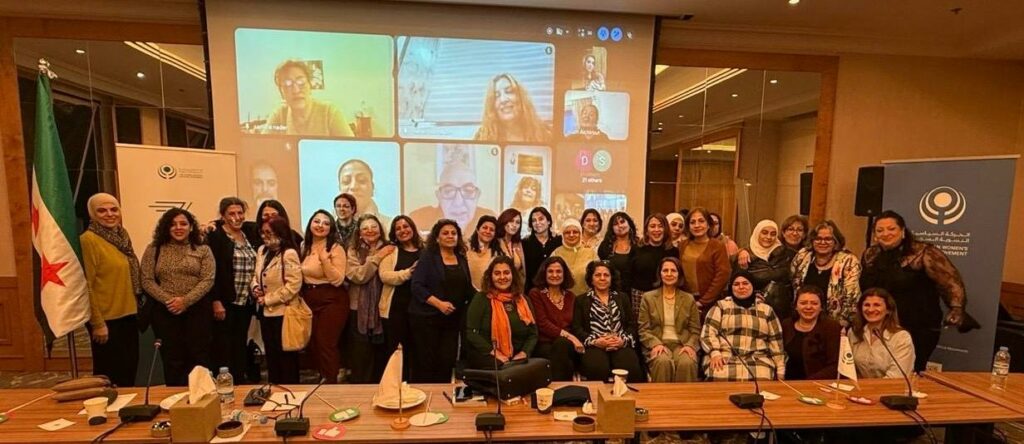
The Syrian Women’s Political Movement concluded its Seventh Conference, held in Beirut from 14 to 16 February 2026 under the motto“Towards Citizenship, Justice, and Participation for All.” We begin our communiqué by noting that we were compelled to hold the conference in Beirut, as we submitted the necessary requests for official approvals to hold it in Damascus but did not receive necessary approvals from the Ministry of Foreign Affairs. We consider this act to be a deprivation of our right to political engagement within our own country. We emphasize that the voices of Syrian women and men should not be confined by borders nor obscured by permits; this is the very cause for which we have struggled for many years.
The fall of the Assad regime on December 8, 2024, constituted a pivotal moment and a historic opportunity for Syrians to build a new Syrian state—a state of equal citizenship based on democracy, the rule of law, justice, partnership, and the guarantee of rights without discrimination on the basis of gender, religion, sect, ethnicity, or any other affiliation. However, the subsequent period has revealed serious challenges that continue to obstruct the transition toward the desired state.
Syrian women and men have suffered for decades from tyranny and the monopolization of decision-making. Therefore, political participation and inclusivity are not secondary demands, but rather essential guarantees for a decisive rupture with the past and for safeguard against the resurgence of authoritarianism in any new manifestations. Consequently, we see an urgent necessity for launching a comprehensive National Constituent Conference. This conference should span an adequate timeframe, include political, civil, and grassroots actors, represent all Syrian components authentically, and lead to binding outcomes that translate into a clear constitutional and legislative path placing Syria on the track to democracy.
Building a state of equal citizenship requires a constitution that recognizes and protects Syrian diversity, guarantees substantive equality and equal opportunities, and ensures that competence and integrity — rather than quotas and loyalties — are the criteria for assuming public responsibility. It also requires national military and security institutions founded on professional, non-ideological standards, committed to human rights and the protection of civilians, and subject to legal accountability. Any procedural steps in this direction must be accompanied by implementation, transparency, and guarantees against regression
Transitional justice remains a priority that cannot be postponed after long years of conflict and violations. It is a prerequisite for safeguarding civil peace, preventing recurrence, and rebuilding trust among Syrians. Although a Transitional Justice Commission has been announced, it has not yet commenced its work. We therefore stress the necessity of its full independence, the provision of adequate powers and resources, and the adoption of a comprehensive approach encompassing truth-seeking, accountability and the end of impunity, reparations, institutional reform, and the protection of witnesses and survivors. We renew our condemnation of any grave violations or bloody events witnessed in the country, including the massacres in the coast and in Sweida. Protecting civilians, upholding the rule of law, and ensuring fair accountability are the only paths to preventing cycles of revenge and recurrence.
We reaffirm that there can be no path to coexistence without national and societal dialogue that fosters acceptance of the other and confronts hate speech and discrimination. We therefore call for grassroots community dialogues that create safe spaces for mutual recognition, dismantling of multifaceted grievances, and engage with past narratives with courage and responsibility, leading toward a new social contract that lays the foundation for a participatory future.
Syrian women have been — and continue to be — among the groups most affected by exclusion and tokenistic representation. They are among those most in need of a state grounded in citizenship, justice, and participation. We reaffirm our commitment to continuing the peaceful struggle to ensure women’s full and equal rights in the constitution and laws, and to guarantee women’s meaningful and influential participation in decision-making positions and at all levels of public administration, as a prerequisite for building a just and stable state.
The Assembly discussed and adopted a position paper on the current political situation and the SWPM’s stance, which will be published soon. Participants also reviewed the Annual Political Report and the Movement’s key achievements between the two assemblies, foremost among them the Feminist Political Track. Through this track, the Movement facilitated a dialogue among 14 political and civil components regarding civil peace, the mechanisms for its realization, and its interconnection with the political process, transitional justice, reconstruction, national identity, and the social contract—culminating in recommendations recently launched by SWPM. Furthermore, the Assembly reviewed policy papers issued by the National Consultations Program, which conducts regular dialogue rounds with Syrian women across various regions. Attendees also discussed the Young Women Politicians Forum project and the paper recently produced by young women leaders, reflecting the vision of young women and men regarding their role in the transitional phase and in building civil peace in Syria.
In conclusion, we reiterate our regret at being unable to hold our conference in Damascus. Syria has always been — and will remain — our compass. We remain committed to work toward a state in which human dignity is safeguarded and democracy, citizenship, justice, and participation are realized for all.
related